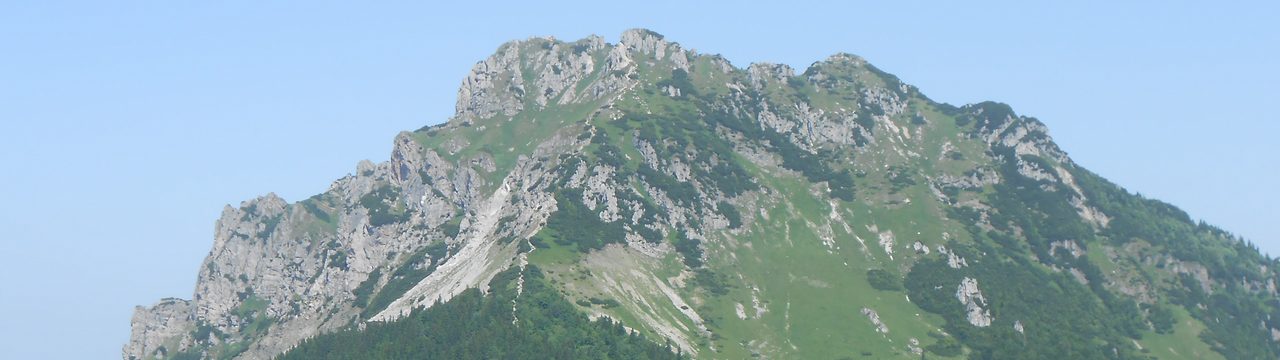
The end of September had me go on a four-day trip to the Slovakian Karst area (and national park) – a place that seems quite a bit forgotten despite being the location of four UNESCO heritage caves.
The first day
We set out on the 28th, which is a national holiday here in the Czech Republic, but not in Slovakia. That proved to be a problem right from the start – shortly after crossing the border, we got stuck in traffic, and this remained with us for way too long. The journey, which was supposed to take around 4 hours under normal conditions, was barely half-done by that point. When we finally made it past the bottlenecks, it went well for a while, but on the winding mountain roads, we were once again slowed down by road repairs.
Instead of around 10:30, we reached our destination around 13:30.
Thus, I headed from the bus right into the woods, with time being in short supply, as we planned to depart around 17:30 given that we had a 30-minute trip to the accommodation. The trail took us uphill right away, reaching the plateau of which we were to walk the southern half.

Soon after, the trail entered a dense forest and seemed… quite unused, given that the foliage was barely beaten. It provided a welcome shade from the heat but also made it a bit hard to navigate as the trail was very faint at times. Around us, the landscape looked like it was subject to heavy bombardment – overgrown bowls sometimes up to 50m deep could be seen around. These bowls are, however, formed by the disruption of the underlying layers of limestone. Unfortunately, the dense woods made them almost impossible to photograph.
Despite the dense woods and the lack of use, the trail was at least marked well, so we could keep a brisk pace. Eventually, we neared an abandoned marble quarry that was already getting quite overgrown with vegetation.

Shortly after, the trail took us across a field with some nice solitary trees, further improving the scenery with the low light of the autumn afternoon sun.

The trail then led us back to the woods, around more bowls, all the way toward the Slovakia-Hungary border where one of the major caves is. Unfortunately, by that time (17:15), it was already closed as it’s off-season and the tours for the public were reduced to four a day, the last at 14:00. Which I found quite weird, ending this early – most caves in my country are, even outside of the main season, open longer.
The second day
On the second day, we were to cover the northern part of the plateau. The bus took us to the site of the second cave, and we arrived around 8:45. The first tour? 10:00. The guide was already there, but taking a group of around 30 people on an extra tour? Nope. Unfortunately, the organization that runs these caves (belonging to the Ministry of Environment) is adopting a “f*ck potential customers” approach – no reservations ahead, no ticket sales ahead, no online ticket sales, no extra tours for groups, and no paying with bank cards” – like in the old times, get there and hope for the best. What the hell?
So, rather than to wait there during a chilly morning, most of us decided to head out for the hike. Same as the previous day, the trail started with an ascension to the plateau. The field graced us with flowers but also had us searching for the trail a bit as it was to enter the woods but where, exactly, wasn’t marked well. We found in a bit that the path was overgrown by a thorny bush. Yay!

Walking through the woods, the trail took us to another cave. Here, we could admire it from a lookout. Down below, it’s an ice cave, and further down, it feeds into an underground system that leads to the cave where we started an hour ago. Standing on the lookout, we could feel the chill rising from below. The white rectangles in the photo above are likely some seismic and/or temperature monitors.

Soon after, we reached a small town and, from there on, the trail took us over vast fields – the northern part of the plateau is roughly 7x10km large spot of land left to its own devices. Some parts are fields and pastures, some are dense woods, and much is something between them. Sinkholes overgrown by various vegetation dominated the fields, some of them up to 30-50 meters deep.

The trail weaves between them, seemingly without an end.


And the fields were also rich in mushrooms.

Eventually, the fields gave way to woods, but the landscaping was still very similar – just more overgrown. I guess that’s partially because it’s far from the village to use as a pasture, which is the only way to prevent the fields from getting overgrown. In the woods, we passed by a “chimney” abyss – a narrow (ca 1×2 meters) chasm almost 200 meters deep, based on what the educational board standing by said. From then on, it was mostly weaving through the woods, until we reached the end of the plateau, and descended towards the village where we were staying.
The third day
The third day led us to a place that was a bit different – instead of a plateau with bowls, it’s cut apart by a deep chasm. We started in a village at the mouth of this valley with the limestone slopes looming above.

While most took a trail through the valley, I ascended uphill to see the valley from above. This took me a while, but it was well worth it. As if I was there at the right time, the sun lit up the limestone, revealing a sight like few others.

I took a footpath that skirted around the edge of the plateau, enjoying the sight for quite a while. Even though the photo might make it seem the place is overgrown all the way to the edge, there were plenty of lookouts. Some of them grassy, some of them shaded by trees.

I continued following the valley using the footpath and then the upper trail for a while, then the trail turned a bit away from the valley – but not before another lookout.

Emerging from the woods, I was once again walking across vast fields – though these were free of sinkholes.

An educational board nearby revealed how much the grassland has shrunk since the 1950s, giving way to woods. Efforts are being made to thin out the woods to restore the grasslands and give space to rare species of flowers bound to these warm grasslands. Originally “maintained” by herds of sheep or cows, these fields are, for now, being tended to mechanically, though there are plans for financial support to locals willing to get their livestock to graze on those fields.

The fields and the edge of the woods also featured “groves” of Macrolepiota procera mushrooms – sometimes, dozens or even hundreds could be seen nearby, ranging from young, still closed to mature, fully extended species with their cap around 30cm in diameter.

Descending to the village below, I took a short detour to nearby small waterfalls – they had a strange appearance, looking like some kind of slide. I theorized that the limestone in the water interacted with the mud to form some kind of natural cement, thus creating these slides with the help of the root systems of the nearby trees.

Then, I turned towards my final stop – a castle ruin above the village.

The fourth day
The final day was more an outro than a full day spent in the area. The main target was a nearby cave, found in 1954 by miners who broke into one of the halls by chance.
Before visiting the cave, I decided to take a short hike – instead of being dropped off at the cave’s parking lot at taking the 9:30 tour, I was dropped off at a village below, aiming to make it to the caves for the 11:00 tour.
The trail I took went through the woods all the time, so there wasn’t much to see as for lookouts, but I had managed to enjoy some beautiful fungi. Such as this twin Leccinum scabrum mushroom.

And a small bolete.

I made it to the caves with some time to spare. Given that I didn’t trust my phone to take decent photos in the dark, I didn’t buy the photo permit – paying 10€ for a couple of smudges didn’t seem like a good use of my money. Maybe that was a mistake because the marble walls and aragonite crystals in the cave were something to behold.
But worry not, I won’t let you go without at least a hint, so you can see some photos from this particular cave on Wikipedia.
With that, the four-day trip was over, and we were on our way home. After a talk with the driver, we settled on an alternate route, and managed to bypass some problematic points from our initial journey. Thus, we got home without getting stuck in traffic again.
So, that’s it for the last hikes of September (and the first hike of October, as the last day was on the first). Despite the date, summer wasn’t giving up its hold on Europe just yet, and there were further warm days coming – but that’s something for another day.
Until then, I hope life’s been treating you well. See you next time.
 Tomas - the wandering dreamer
Pingback: 10/2023 Summary | Tomas - the wandering dreamer